> For the complete documentation index, see [llms.txt](https://docs.wiclax.com/llms.txt). Markdown versions of documentation pages are available by appending `.md` to page URLs; this page is available as [Markdown](https://docs.wiclax.com/en/use-wiclax/acquisition-of-timing-data/the-different-systems/mylaps.md).
# Mylaps
Mylaps is a Dutch manufacturer of RFID timing systems\
Official website: \
Technical documentation:
Wiclax allows you to connect to Mylaps systems in two different ways. Either directly, for hardware communicating with the P3 protocol, or via the Timing & Scoring software provided by Mylaps.
### Connection through Timing & Scoring
Wiclax connects to the Timing & Scoring software to retrieve readings in real-time.
{% hint style="info" %}
The Timing & Scoring software can be installed on the same PC as the PC hosting Wiclax. In this case, you will need to enter the network address 127.0.0.1 to communicate with it.
Another architecture is to install the Timing & Scoring software on an independent PC. In this case, this PC must be on the same local network as Wiclax and the network address to be entered will be that of the PC hosting Timing & Scoring.
{% endhint %}
In Timing & Scoring, you will need to create one or more "Exporters" to send passing data to Wiclax. Note that each exporter will need to be configured with a different port.
Note that by default, the exporter is created with the localhost address, which is perfect if Wiclax and Timing & Scoring are on the same PC. Otherwise, you will have to replace "Localhost" with the IP address of the PC hosting Wiclax.
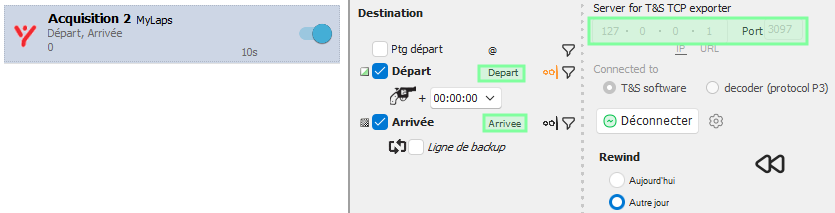
As you can see in the animation, once the export is created, you must select the timing lines previously created in Timing & Scoring (Here, Depart and Arrivee).
On the Wiclax side, we will enter the IP 127.0.0.1 (local loop) and the port 3097 which must be identical to that of the exporter. If the exporter transmits the times of several different timing lines, we will enter this one in the source column with a label strictly identical to that present in T\&S. Here Depart and Arrivee which will respectively feed the Start and Finish.
---
# Agent Instructions
This documentation is published with GitBook. GitBook is the documentation platform designed so that both humans and AI agents can read, navigate, and reason over technical content effectively. Learn more at gitbook.com.
## Querying This Documentation
If you need additional information that is not directly available in this page, you can query the documentation dynamically by asking a question.
Perform an HTTP GET request on the current page URL with the `ask` query parameter, and the optional `goal` query parameter:
```
GET https://docs.wiclax.com/en/use-wiclax/acquisition-of-timing-data/the-different-systems/mylaps.md?ask=&goal=
```
`ask` is the immediate question: it should be specific, self-contained, and written in natural language.
`goal` is optional and describes the broader end goal you are ultimately trying to accomplish on behalf of the user. GitBook uses it to tailor the answer towards what is most useful for that goal.
The response will contain a direct answer to the question and relevant excerpts and sources from the documentation.
Use this mechanism when the answer is not explicitly present in the current page, you need clarification or additional context, or you want to retrieve related documentation sections.